Showing posts with label speculation. Show all posts

Thursday, January 14, 2016

Could the US Navy's Next Cruiser be Derived From the San Antonio Class LPD?


Huntington Ingalls Industries is in discussions with defense officials about potentially putting missile defense radars and laser weapons on San Antonio-class amphibious transport docks, a company executive said Jan. 13.

“You can put a lot of additional weight on the ship and you can put … some modern technologies like ballistic missile defense radars that are very heavy,” Brian Cuccias, corporate vice president at HII and president of Ingalls Shipbuilding, told reporters on the sidelines of a Surface Navy Association symposium in Arlington, Virginia. “We think it’s a great idea.”

The vessels, which are manufactured by the company, have design features that make them well-suited to carry a large radar, he said

“You have a design life margin …. on some ships that say you can only take so much more weight before you have a stability issue or, you know, you don’t have your margins,” he said. “When you close in the well deck of the LPD ship you expand that capability to take a lot of weight, and the stability on LPD is such you can actually put weight up high” where missile defense radars would be positioned.

One of the challenges of hosting ballistic missile defense radars is the need to power them and cool them, Cuccias noted. “You need arrangeable volume for power generation. You need arrangeable volume to have cooling,” he said. “LPD allows for that. … The basic bones of the ship allow that to take place.”

[...]

The Navy is hoping to equip some of its ships with high-powered lasers and electromagnetic railguns to enable them to shoot down enemy missiles and aircraft and attack surface targets with the emerging technologies. Cuccias said the LPD could potentially host those types of weapons.


The article above does not say the ships would be the replacements for the Tico cruisers, but that is effectively what is being talked about.  So let's consider it.


On the Plus side:

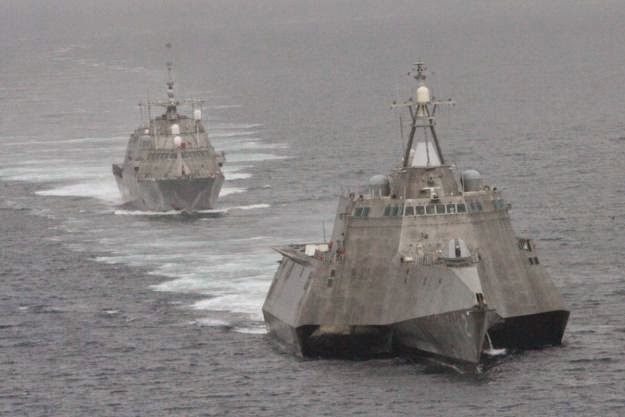
1.  The  LPD's are huge.  Just look at the picture right above.  There are two San Antonios present side by side and a Ticonderoga in the foreground.  You can see the vast size difference.  The LPD's displace 28,000 tons, whereas the Ticos displace ~9,800 tons.

2.  The volume is huge within the San Antonios as well.  There's plenty of space to place pretty much anything.

3.  The hull is a known quantity and would save some money by being reused.  A simplified form of the hull is being used for the LX(R).


On the Down Side:

1.  The LPDs need a complete revamp for their propulsion.  Right now they use diesel engines able to move the hull a sedate 22 knots.  The Ticos move at a rate of ~32, almost 33 knots and this is far slower than the carriers with their nuclear propulsion.  

2.  The hull needs to be updated for carrying more helicopters - we got away from strictly specialist ships after the ending of the Burke Flight I destroyers.  The flight deck is plenty large, but the hangar space is far, far too small.  

3.  The hull needs to rebuilt so far, far more VLS cells can be added to the ship.  Currently, there are provisions for 8 VLS cells.  A cruiser needs 120+ and probably ought to use the more up to date Mark 57 vs the Mk 41 allowing for dispersing the cells through the hull for better survivability and  larger missiles.

4.  The lasers and railguns speculated on are a great idea...but its unknown how much they will cost in the end.  The savings of using the LPD hull may be a very, very small portion of the cost.  

5.  Power generation.  The diesel engines on the LPD-17 class are not going to be sufficient for the continual firing of railguns or fleet defense lasers.  This is only worsened by the fact in combat the ships must move as well.  However, there is the volume to replace, well everything and significantly add on.

6.  Its highly likely the electric propulsion system for the Zumwalt class will have to be adapted for the new LPD derived cruiser.  This would mean needing to upscale the system: the Zumwalts are 19,000 tons.  The new LPD derived cruisers would be at least 28,000 tons.  And scaling is a huge issue with any project.


Idle Thoughts:

1.  I suppose if the American definition of 'destroyer' is 19,000 tons now with the Zumwalts, it would make 'sense' the cruisers would be 28,000 tons.  :)

2.  This has potential, but I worry this will get killed the same way the Zumwalts did through rising costs triggering the death spiral.

3.   I also wonder about the survivability of the ship that was originally an amphib.  They are built with different expectations than the cruisers and destroyers.

4.  A dedicated BMD ship is a bad idea (see image right above and below).  The use of lasers and railguns will really change that design as well.


its an interesting idea.  We'll see if it goes anywhere.

Monday, June 08, 2015

Yet Another Mini Crazy Thought: The JP Jones Class Destroyer


"USS JP Jones" at top, USS Zumwalt below at scale
stop mocking my photoshopping!!!


I've been playing around again.  This picture is hardly as good as what I did to create the second MC Perry class, but it does outline what is possible for a potential next generation destroyer.  While, like the MC Perry, the JP Jones is a name which is already in use, the point is to pick a name which is recognizable and easily short handed (and probably will end up getting recycled).  This is meant to be what I think, roughly, what the Navy's Future Surface Combatant ought to be.

I left a copy of the Zumwalt next to the JP Jones for comparison sake.

The missions of a destroyer in the US Navy is both that of an escort and as an independent combatant.  With the except of the Zumwalts, all current American destroyers are anti air guided missile destroyers.  This is primarily because other than the Zumwalts, the only ships which we have are the various flavours of the Burke class.  Likewise, the other role which the Burkes fill is of ASW, anti submarine, hunters.  Except the earliest versions of the Burke, they carry a pair of helicopters to hunt subs.

The JP Jones is far, far more conservative than the MC Perry.  To be sure, they share a lot of the same weapon systems, but the MC Perry is a far smaller hull with a lot of nontraditional approaches taken.  The Jones is more in line with traditional ship building.

There are nontrivial differences with the JP Jones compared to the previous generations of destroyer.  The JP Jones is meant as an escort and an independent combatant when necessary.  Its also meant to take on a lot of the newer technological weapons the Chinese, the up and coming power, have and will develop.

The JP Jones is shorter than the Zumwalt by 25 feet.  However, it displaces significantly more: 3,200 tons more (making her almost 19k tons).  This is due to the fact the Jones have a more traditional bow.  The draft of the Jones is deeper as well: about 3 feet, but still.  The beam matches the Zumwalts.  The deckhouse is shorter than on the Zumwalts, too.  The total crew is larger than the Zumwalts (190 vs 140).

The Jones will have a Aegis/ADMR radar combination.  A sonar tail would also be necessary, but also a set of UUVs which would be able to dive to different depths for sonar coverage while linked to the destroyer. 

The Jones class sports more VLS cells than either the Zumwalt or the Burke.  The largest number the Burkes have is 96.  The Zumwalt has a total of 80.  The Jones will have a total of 108 cells.  These are the same MK 57 cells, like the Zumwalts, allowing for larger missiles in the future, over the Mk 41.  While acting as an escort, I'd expect 16 cells to be filled with ASROC, 16 cells to be filled with 64 ESSM, 8 cells to be filled with LRASM (or TLAM equivalent) and the rest of the load out would be SM series missiles (68).  When operating along, the SM series would probably be reduced in favor of Tomahawks or whatever replacement missiles there are.  Likewise, when they become available, the LRASM will likely be replaced by a hypersonic missile.

However, those are not the only weapons on the ship.  In the past, they would have constituted the primary weaponry and in many ways, they still are.  However, that's not all that is being touted for here. 

Like the MC Perrys, the JP Jones' have a railgun.  This is meant for both naval gunfire and when coupled with the radar, to be a defensive BMD weapon: a little hard to run away from a mach 7 projectile.  The reason there are not two railgun guns is due to the power equipment, power requirements and just plain real estate: there is only so much volume and space on a warship of even this size.

Also like the MC Perrys, the Jones' have kept up with the high energy lasers.  There are two megawatt class fleet defense lasers and two weapons grade self defense lasers.  The former are atop the deckhouse and are meant to protect at long range the entire battle group, whereas the self defense lasers are on the port and starboard deck and meant for a combination of CIWS and ASuW work.

The Jones' retain the large flight deck of the Zumwalts and nominally carry 2 SH-60s, 4 firescouts and 2 TERNs.  The VTOL capabilities are intended to be primarily for sub hunting.  However, the TERNs are meant for the ISR and light strike role.

Okay.

Why this load out?

For example, why keep so many VLS cells when you have lasers and a railgun?  Backup.  Really.  There are circumstances when the lasers will be degraded based on weather and other factors.  Its best to have weapon systems which can still engage the targets under those circumstances.  The ESSM will be necessary for certain circumstances.  

I have said this before, but...I will say the ESSM needs an upgrade for the distance which it can engage at given the coming age of hypersonic missiles.  10 miles is 10 seconds from the ship at Mach 5.  That's almost point defense range under those circumstances.  The next generation replacement for the ESSM will need to at least engage to the horizon (30 miles).  The ideal is to be able to have a range such that if the first salvo of missiles against an incoming 'vampire' miss, there is time to engage again.  30 seconds might not be enough even then.

It was tempting to place another railgun at the aft end of the ship and increase the length of ship by another 30 ft.  However, the cost and weight would be high and even more so, placing a weapon which might interfere with the flight deck makes me uncomfortable.  The VLS cells in the aft are only there as a backup in case the bow cells are damaged.  However, it has been done before and could be considered.

ASW is going to be just as important for the destroyers of the future.  The torpedo tubes will be necessary on ship as well as the ASROC and its eventual replacement.  The new ability to carry unmanned underwater vehicles (drone subs) will be very important.  These will give sonar and other sensors in areas where the destroyer is blind currently.  Eventually, those UUVs will become armed and have short range torpedoes of their own.  In the mean time, the ability to hunt subs both from the air with the Firescouts and SH-60s and underwater with the UUVs, sonar tail and shipboard sensors, will improve the situation over what it is now significantly.

Escort duties:

A carrier battle group would have a Nimitz or Ford class carrier, a pair of cruisers (the Gravelys, to be written up), three Jones and two Perrys.  

Currently, a CVBG has ~424 cells.  Between the Perrys and the Jones, there would be 388 VLS cells.  The Perry and Jones would add 5 railguns, 8 megawatt class fleet defense lasers and 6 multi hundred kilowatt self defense lasers.

Currently, neglecting the ASW helicopters on the carrier, the escorts have a maximum of 8 SH-60s.  The Perry and Jones have ten, but they also have 16 firescouts.  This is part of the reason I was thinking to shift off the ASW assets from the carrier airwing.

Additionally, the Perrys and Jones would add 10 TERNs to the mix for ISR.  With this number you can keep between 2 to 3 TERNs constantly in the air at a minimum without worrying about wearing them out.  This is also why I'd think the UCLASS ought not be focused on ISR.  If you embrace the Navy's 'distributed lethality' idea, the destroyers, cruisers and frigates would be able to provide the ISR.  The carrier ought to focus on the high end then.

Sketching in the Gravelys (scaled up Jones class like the Ticos were for the Spruance), you end up with over 700 VLS cells, 9 railguns, 14 fleet defense lasers, 10 self defense lasers, 12 SH-60s, 24 Firescouts and 18 TERNs.  ASW (from the VTOL POV) and ISR are sufficiently covered.  Ballistic missile defense is also covered: the railguns can fire 54 rounds per minute in aggregate and could take out that number of missiles.  With ~5 second engagement times, the fleet defense lasers could take down 84 Mach 5 sea skimming missiles.  The self defense lasers could take down a max (though they'd have to be coming in the right way (HA!)), of 30 Mach 5 sea skimming missiles with a ten second engagement time.  If each ship had 64 ESSM, totally 448 missiles, then in a hypersonic attack scenario, they could take out up to 112 Mach 5 sea skimming missiles.  That means it ought to be possible to take down a total of 226 hypersonic missiles (280 if the rainguns are used against the seas skimmers).

Total cost for that defense is less than $160M.  The total cost for the attackers is at least $600M if not well over a billion dollars.  With no probable kills. 

And the battle group can engage like this at least four times.

And this does not count the abilities of the standard missiles as well (potentially bagging up to another 120 missiles, if only 1/4 of the SM magazine used).  Pushing the total cost to nearly over a billion per engagement, if not 2. 

And that does not count the ability of the carrier airwing to engage either (like with the fleet defense avengers I talked about earlier).

This means to kill a carrier battlegroup you're going to need to spend as much as the carrier battle group in missiles, if not much more because those pesky lasers and railguns are cheap to fire. 

Defending against subs, we have now 36 ASW VTOLs flitting around the battle group a 4 1/2 times increase.  Additionally, the use of UUVs makes for a dramatic increase in the number of submerged sensors as well.

If the US Navy keeps 11 battle groups and you are an opponent of the US at war with the US, at least 5 of those are going to be approaching your coast.  Assuming it takes $20 billion kill a battle group, you're looking at $100 billion (or one Apollo Program) to kill all 5...and they have 6 more siblings to seek vengeance with.

Other thoughts:

One concept which I have been 'in love with' since the 1990s, but don't see happening is the DDV.  This is a destroyer that carries its own F-35Bs.  The DDVs were meant to give CAP and strike capability only available to carriers without trying to be a full blown carrier.  Originally, the idea was to have 2 F-35s, four SH-60s and whatever drones were available.  A surface action group with four DDVs could keep a continuous CAP.  A single DDV would be able to keep an ASW patrol up 24/7 without the drones, but with the addition of the Firescouts this could be an extensive, persistant ASW patrol.  An updated theoretical airwing of a DDV would have a pair of F-35Bs, four SH-60s, 6 Firescouts and four TERNs.

However, when adding in the normal capabilities of a destroyer (VLS, sonar, etc) plus the aviation capabilities, you are looking at a very big ship.  To accommodate the F-35s, even only operating in the VTOL mode, you're looking at needing a flight deck of 80 ft wide and a 101 ft long: you could go smaller, but it'd be really, really tight.   I'd speculate this would become a beam of 80 ft and a length of at least 650 ft for the ship.  That would lead to a near 20k ton ship.  The cost would be prohibitive and then there is the need to procure more F-35Bs: they cost ~$104M each and each ship would need four.  Yes, four because two will be deployed, one spare would be needed back Stateside and the other is effectively the loss replacement, when, if planes are lost.  That alone increases a ship's cost by $416M and this ship is likely to cost as much as a Burke: $1.9B.  And while giving some unique capabilities, its a jack of all trades and master of none (smaller # of VLS, etc).

Alas.

Remember folks, this is all in fun.   Kind of the beer and pretzels discussion equivalent of blogging.

Sunday, May 03, 2015

Stretching my Image Manipulation Skills: USS MC Perry


meh.  Just playing around.  

The USS MC Perry at the top and the USS Independence at the bottom.  The original image is at the bottom, of course.

The railgun up front is what I am least happy with but at least its to proper proportion. Not overly happy with the SPY-1F either.

The ship and class need a new name since there's already a USNS Matthew Perry.

Friday, May 01, 2015

Mini Crazy Thought: the USS Matthew Calbraith Perry, What the LCS Derived FF/G Circa 2020 Ought to be

The US Navy has been buying rather small corvettes which have been called the Littoral Combat Ships. They are fast and intended to be patrol vessels of a sort to deal with the small swarming squadrons of gunboats or fast attack boats and pirates as well as provide for help when there are disasters, etc. They are quite fast at 44+ knots each. However, they are very lightly armed: in terms of armament, a Cold War Coast Guard Cutter (with Harpoons) would be able to take one out.

There are two flavors of them, the Freedom and the Independence classes.

However, there has been a huge hoolah about the fact they are so weakly armed and so expensive (between $450 million to $500 million each, neglecting government furnished equipment).  This prompted a call to cancel the LCS contract and for a replacement which could fight in a full bore battle rather than be glorified coast guard cutter (though admittedly, if they get the Hellfires actually installed, they will be able to kill things out further...a whole 5 miles).  Keep in mind, the ship they are 'replacing' is the Cold War Oliver Hazard Perry class frigate, which no matter how you slice it, they had far more firepower than either of the LCS.

The Navy as a result commissioned the Small Surface Combatant study to see if a full frigate was affordable and what industry could do.  Lockheed and Austal proposed upgraded versions of their LCS classes.  General Dynamics offered an nonpublic bid.  Huntington Ingalls offered an upgraded version of their National Security Cutter.  The Navy settled on modest upgrades to the LCS classes much to the eye rolling of their critics. 

It got me to thinking, what ought we to do, in my opinion?  

A seemingly segue, but its relevant: the US Navy canceled its Zumwalt class destroyers after ordering three.  They were too expensive is the usual commentary, having suffered through the development/procurement death spiral.  There's another consideration too: the Zumwalts were delayed sufficiently that newer technologies were on the cusp of making their armaments obsolete.  Frex, the Advanced Gun System will be outranged  by the railguns being testing at sea next year and the rounds for the railgun will be $25k each or less: far lower than the AGS'. 

While the Navy seriously needs to get its act together for its surface combatants, like getting a new destroyer and cruiser program started and done within budget and on time while dealing with future threats, I wondered what could you incorporate into a frigate.  And where would you want to start?

It does help if it is possible to use as much as the same equipment as before, propulsion, mechanical and hulls, just to save money.  That would imply an existing hull design.  That in turn, based on politics, means something built in the US.  That means one of the LCS or the National Security Cutter.  The cutter isn't in the navy logistical path, so it ought to be cut based on that.  That leaves us with Freedom and Independence.


The Freedom class is a steel hulled ship (a plus) with some room for growth with minimal changes and its faster than the Independence class (47 knots vs 44).  It has 180 tons which it can accept without adding sections and whatnot.  However, significant changes would need to take place for more.  Its internal volume is significantly smaller than the Independence, too.  However, a lot of the upgrades Lockheed proposed for the SSC variant were spot on.  However, some I'm considering here make that internal volume a significant problem. 

The Independence class is aluminum hulled and slower than the Freedom class.  Its also, in terms of volume, enormous.  It also has a very large flight deck.  It also has the capacity to take 210 tons (vs the Freedom 180) as part of its mission packages.

Due to the volume and more mass to work with, the Independence seems like the best starting place.


The 'proposed' Matthew Calbraith Perry class frigate:


for comparison, I left the Independence class under the 'proposed' Matthew Calbraith Perry class.
sorry, couldn't do a good railgun turret, esp in the front, so I left the old one. 
HEY!  Don't mock my meager image manipulation skills!   
The MCP has an enlarge upper superstructure (adding about 300 tons) allowing for the addition of another LM-2500+ (generating 35 MW of power, adding 100 tons) and its fuel stores.  The LM-2500s already installed are replaced with LM-2500+'s.
The aviation hangar is the same volume, but flight deck shrinks by a third: its still larger than the Freedom class' flight deck.  It retains the two SH-60 ASW helicopters, adds a second Fire Scout, and adds two TERNs. 

A hull sonar is added (probably at this point the same as the Burke's AN/SQS-53C, weighing 26 tons) and the towed sonar array is kept.  An Aegis combat system is added with an SPY-1F array, adding another 20ish tons and requiring 3 MW.

The proposed SeaRAM self protection missile system is kept and an additional 32 Mk 57 VLS cells (72 tons) are added.  I'd speculate you'd have a load out of 16 cells of 64 ESSM (or successor), 8 ASROC (or successor) and 8 LRASM.

For close in ASW problems, two sets of Mk 32 Torpedo tubes would be ideal (or a successor, really).  These would weigh a total of 5 tons.

Here's where things get a little radical.

While our little frigate packs the punch of some destroyers now with the configuration above, it doesn't explain why we needed the volume of the Independence class or the power from the LM-25.  By upgrading the current LM-2500s to LM-2500+'s, we get a enough power for the new sensors (sonar and radar) without sacrificing speed.  However, the new weapons require more power than what could be sacrificed even with the upgrade.  What are those?  Yup, lasers and railguns.

Proposed here is to replace the 57mm cannon with a 155mm railgun, like what is to be tested next year on the JHSV.  The range will certainly be longer 60+ km vs 17 km.  The impact damage certainly higher.  The railgun can also be used in an antimissile capacity.  The rounds are very cheap, relatively speaking.  Amusingly, the railgun itself is pretty light weight: around 15 tons, about the same as the 57mm cannon!  However, its pulsed power system is very heavy and takes up several shipping containers in size.  That enormous mission bay of the Independence ought to be able to fit the pulsed power system.  Additionally, the weight ought not to be over 180 tons.  Together with the railgun itself, this is around 200 tons.

The second 'radical weapon' would be a laser.  I don't mean the LAWS system, but rather a weapon's grade laser (100 kw+) which would be used for both small surface targets and anti air and anti missile roles.  Considering we want to have a very low dwell time, we need a megawatt (erm, really megajoule) class laser.  There are two ways to do this.  Either we can wait for the free electron laser (on track, but going slow) or use a solid state laser.  DARPA's HELLADS laser fits the bill and has demonstrated a weapon already at General Atomics.  One which GA is planning on integrating on its Avenger drone (which I took and ran with).  If we aggregated the HELLADS modules, we can get a megajoule/pulse class laser: you need a total of 20 modules.  If one is half a ton, then twenty is 10 tons more.  If you count in optics, beam director, and extra cooling and power, you're looking at somewhere around 30 tons.  And the power requirements!  Oh the power requirements!  Let's just leave it at 'gimme.'  Okok, each pulse minimally will need 1.2 megajoules and if you plan on having more than one pulse per second you need to multiply the number of pulses you want by the 1.2 MJ.  The absolute most you can get is 22 pulses/second. 

(yes the butchered RAM launcher on the top of the MCP doodle is meant to be a beam director.  stop mocking my art!).

Now the question is, 'how fat did our baby get?'

Truthfully, we have added 750 tons of structure, sensors and weapons.  That pushes our ship to being 3800 tons fully loaded...without the extra fuel for the LM-2500+ for the new weapons and sensors!  Fortunately, even if we are carrying an extra 400 tons of fuel, we are will still be able to eek out another 2 knots from the upgraded engines.

Now how expensive is our baby?  We get roughly a cost of $820 million vs $464M for an Independence class.

So.  Why?  Why do it?  Its almost twice as much as an Independence class LCS.

The first answer it gives the US a huge numerical edge with well equipped, well armed combatants: the Burkes cost $1.8B each.  For five Burkes, you can get 11 MC Perrys.  

Second, you have a ship which act as an escort for an aircraft carrier.  One of the amusing bits is the monster sized aircraft carriers can sprint far, far faster than the escorts can.  The escorts, destroyers, etc, can do around 30 more than 30 knots, but the carriers can do well over 40 knots with the nuclear reactors.  In emergencies, carriers have sprinted ahead and rendezvoused with different escorts at its destination or been forced to be unescorted at its destination.  While the MC Perry is not a Burke in terms of capability, it will have some distinct capabilities: lasers and railguns are rather cheap per shot.  And, this is done without needing to resort to nuclear power plants for your escorts.

Finally, even when the Burkes and Ticonderogas or follow-on replacements are present, these new FFGs add a distinct capability as advanced screening ships like the previous Perry Frigates did for the carrier battlegroups. 

Aren't the laser and railgun a little immature?

If the lead ship, called Matthew Calbraith Perry here, is laid down in 2020 as the SSC plan calls for, then commissioning will take place in 2024.  Ten years from now.  The railgun is most likely going to be replacing one of the Advanced Gun Systems on the USS Lyndon B Johnson, the last Zumwalt.  The USS LBJ will be commissioned in 2021, a year after the laying down of our proposed MCP.  The HELLADS program will have been wrapped up and could, like with LRASM, be transitioned into a procurement relatively easily.  


Now, do I think this will happen?  

...

Yer funny.

However, back in the mid 90s, a silly for fun project I did on Usenet caught the attention of the Navy before and they asked me to do a little analysis for them.  I did but didn't take what was offered afterwards.  While I doubt I'll be offered anything here, maybe, just maybe, this might tickle someone with influences own ideas and alter course a bit.  

Maybe. 


Afterword:  its becoming obvious in the coming world of hypersonic weapons and antiship ballistic missiles and potential peer naval powers, a lot of our Navy's kit needs replacing.  I am not talking about the ships: that too.  Rather I am talking about the missiles and whatnot.  The Standard Missile is being upgraded, so less worries there.  LRASM is in play, so good start, but progress towards a VLS launched hypersonic missile is needed.  Likewise for a hypersonic Tomahawk replacement.  The ESSM has a range of 10 miles....that's 10 seconds for a Mach 5 missile and 5 for Mach 10: if it misses or fails to take out the hypersonic missile, you're not getting a second shot at that distance.  

For that matter, ASROC definitely is old and ought to updated if not had a replacement made.   etc. 

Thursday, August 22, 2013

Noctis Labyrinthus Looks Like a Cross Between the Scablands and Greece


The Noctis Labyrinthus looks like it was meant to be a Martian Greece.  Or the Scablands(*).  Alas, its too high up even at the canyon floors to be Greece.  The eastern end of the canyons would have ocean access, but the western not...huh.  The canyon walls would be ~4000m/13,000 ft.  10 to 20 km/6 to 12 mile wide canyons, too. 

The Xanthe Terrae seems like it'd be an interesting place if Mars was ever terraformed to have an ocean.  (I prefer the 350 m depth on Toth's map).  Tropical, for Mars, right smack in the middle of the equator and off the oceans.  Its a peninsula with the 'neck' being VERY high lands.  With the Hadley cells, I'd imagine it'd be dumping rain there like crazy.

However, I'll still take Elysium.  Its going to be an awesome island.


*. anyone looked for evidence of an uber glacial lake above?  A Martian Lake Missoula? 

Thursday, June 27, 2013

US Army Aviation Gets a Little SFnal


The movie, Aliens, has been credited with greatly influencing the attempt to create a lot of the technology which was explored around 2000: OICW vs the Pulse Rifle, the health and video feeds on the Colonial Marines vs Land Warrior, etc.  One blog stated this video implies Avatar and halo influences instead.

Truthfully, the video is very, very conservative.

Friday, June 21, 2013

First Crazy Thought of the Day: Martian Life Extinguished by Utopia and Hellas Impacts


I linked to the paper and the posted a chunk of the press release which claimed Mars had a Great Oxygenation Event about 4 billion years ago on Wednesday.  I got a bunch of hits for it.  It seems I was one of the earliest rebloggers of this.  The purty pic didn't hurt, I am sure.  However, the idea itself was interesting...and got me thinking.

4 billion years ago was an interesting time.  For Mars, it was the so-called Noachian System[1]: between 4.1 to 3.8 billion years ago.  This is the wet time for Mars when water was prevalent on the surface.  This is the time frame which fossils of life are likely to be present.  It's also when the oxygen inclusive atmosphere was present. 

 Interestingly, its also when three of the BIGGEST impacts found (short of Thea, erm, with? on? Earth) took place.  The Hellas Basin is one of the most notable impact craters in the solar system.  So notable it was mapped very early when folks pointed telescopes at Mars.  Its 2300 km across.  There's a second, larger, but not as deep impact on Mars: the Utopia Basin, where one of the Viking landers set down.  For that matter, the Argyre Basin (another impact) also formed 3.9 billion years ago.  This one is 1,800 km across.  In contrast, Chicxulub, which did in the dinosaurs was /only/ 180 km across.

The dino-killer was nothing in comparison to these.  

So.  What-if...

Life arose on Mars.  In fact, it was developing faster because the world was cooling faster. It even had a basic continental drift and life was 'accelerating' faster.  The GOE happens 1.6 billion years earlier and life /could/ have been headed to having a hypothesized Ediacarian Period at or around 3.3 billion years ago.   We might have had an intelligent Martian 2.8 billion years ago.  Except...

Mars gets hammered.  Hellas impact's energy alone would produce at least four orders of magnitude more energy than Chicxulub.  This scale of impact happened at least three times, one larger, one somewhat smaller in the time scale which complex life has been alive here on earth, plus or minus. 

While killing microbial life is much, much harder than complex life.  I can all too well imagine something on the order of just one of these be very disruptive, if not devastating.  It might not have killed it off.  However, it might well have killed off photosynthetic, oxygen producing life.  And the chances of a Martian variant of a Gaian system arising.

 So, first crazy thought of the day.

1.  A system is sometimes called analogous to a Period, like the Cretaceous.  However, the length of the Noachian is closer to a terrestrial Era, but that's neither here nor there. 

A quick source (PDF) on mongo impacts on a simulated Mars is here.

Thursday, June 13, 2013

What Does an INDIAN Dominated World Look Like?


For obvious reasons, everyone talks about a world dominated by China.  China is likely to have an economy which will be x times larger than the US on the future's horizon.  For the moment, assume the economic size is remains tied to the population size.  Which case, the projections I have seen for India's population in 2050 is larger than China's by a fair bit.  if the world stabilizes around then, population wise, circa 2100 its probable India will have a larger economy than China will, even if they have the same per capita economy.  Even more so, should China be unsuccessful in reversing the one child policy, say, because the family size has become cultural, this could be even worse (though to be fair, India's TFR has fallen considerably, too.  It does remain above replacement).

Projecting 2100 with rigor is hard.  However, that's never stopped science fiction!  On the other hand, let's try to keep a little rigor here.  What WOULD an Indian dominated world look like?