If you’ve seen any of the Iron Man movies, you know it’s all about the suit.
Tony Stark, as played by Robert Downey, Jr., is the epitome of suave wit—but without his metal shell, he’s just another engineer who’s made good. Once he’s sealed himself into his Autonomous Prehensile Propulsion Suit, though, he has everything from self-repair capabilities to plasma-based propulsion, all guided with the assistance of an advanced A.I. As a vehicle, it might not be as big as one of Larry Ellison’s catamarans, but it’s a lot flashier and can blow things up.
The exoskeleton is a technology platform that, while young, is gaining traction in industrial, medical and military circles. For several years, the U.S. Special Operations Command has been working on a Tactical Assault Light Operator Suit, or “TALOS,” that would provide “provide [infantry with] comprehensive ballistic protection and peerless tactical capability,” in the words of Gen. Joseph Votel, SOCOM’s commander.
Air Force Special Operations Command’s top officer said he wanted to explore the possibility of adding a laser or directed energy weapon to the AC-130J Ghostrider.
Air Force Lt. Gen. Bradley Heithold, head of AFSOC, told a crowd at NDIA’s SO/LIC conference in Washington D.C. on Tuesday that he thought the technology was mature enough to install a laser weapon onto the AC-130J gunship.
The Air Force has already decided it will mount a 105mm cannon onto the newest variant of the gunship after the Air Force chose to limit the W-model to smart bombs and the 30mm cannon. Heithold explained that the 105mm cannon was needed because it was more accurate and cheaper than firing the Small Diameter Bombs.
The Pentagon has continued to expand its research into direct energy weapons, especially the Navy. Top Navy officials have remain committed to incorporating lasers onto Navy warships.
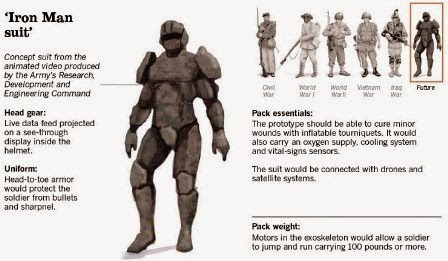

A Pentagon plan to build a real-life "Iron Man" suit has taken some lumps from fiscal hawks on Capitol Hill, but US Special Operations Command's acquisitions chief defended it Wednesday as a way to protect troops using cutting-edge technologies.
In October, the final "wastebook" from Sen. Tom Coburn, R-Okla., listed the Tactical Assault Light Operator Suit (TALOS) program among 100 federal programs he called wasteful. The report knocked TALOS' estimated $80 million budget as a fraction of the projected cost to produce a prototype.
TALOS, although intended as an exoskeleton that allows the wearer to tote heavy gear and an internal computing system, is also an effort to develop a new framework for inventing technologies and fielding them quickly, SOCOM acquisition executive James Geurts said at an industry conference here.
"TALOS to me isn't the Iron Man suit as it is protecting the guy or gal at his most vulnerable point, to give them the capabilities and protection they need to get their mission done," Geurts said. "Just doing an incremental approach to that isn't going to get us where we need to get to. Our collective challenge is to come up with new operating models that make sense."
SOCOM's director of science and technology, Anthony Davis, acknowledged the skeptical press surrounding the program, but said the program's goals are more modest than the "Iron Man" nickname suggests.
"That program is not about putting a nuclear cell on someone's chest and having them fly off to battle," Davis said at the conference. "It's about protecting the operator. The first guy going through the door is our most vulnerable operator."
The United States military could soon have its very own Iron Man suit. The prototype is set to debut within weeks. The suit is a robotic exoskeleton designed to enhance human abilities in battle. Time will tell how well it compares to Tony Stark’s superhero suit, but the Tactical Assault Light Operator Suit (TALOS) is being devised to assist its wearer in lifting heavy loads, protect them from bullets and provide the lucky soldier with information concerning their environment using sensors, cameras and advanced displays. TALOS will have bulletproof armor, 360-degree cameras with built-in night vision capabilities, sensors that can detect injuries and apply wound-sealing foam.
The prototype of TALOS will be ready for release very soon but the more complete version will not be ready for a few years. According to Battelle, a science and technology research institute out of Columbus, it is expected to be ready for actual battle between 2016 and 2018.
In Greek mythology Talos was a giant man, or according to others maybe a bull, made of bronze that guarded the island of Crete. This giant was given the task of patrolling the island by walking around three times a day. Talos would drive pirates from the shore with a fiery death embrace or by throwing rocks.
TALOS is being developed by engineers at Massachusetts Institute of Technology (MIT), the United States Army Research, Development and Engineering Command (RDECOM), as well as other researchers at other academic institutions and businesses. The suit’s technology will be rigorously tested. According to William McRaven, head of the United States Special Operations Command, military personnel hopes to have operational systems join in battle no later than August 2018. If the suit is done correctly it will produce a revolutionary improvement in capability and survivability for special operations.
The U.S. Special Operations Command is using unprecedented outreach and collaboration to develop something special with revolutionary capabilities.
The Tactical Assault Light Operator Suit, or TALOS, is the vision of Navy Adm. William H. McRaven, SOCOM’s commander. He challenged industry and defense representatives at a SOCOM conference in May 2013 to come up with the concepts and technologies to make the suit a reality. The goal is to offer operators better protection, enhanced performance and improved situational awareness.
McRaven spoke more recently at a February 2014 National Defense Industry Association Special Operations/Low Intensity Conflict symposium, in Washington, D.C.
“The TALOS program is a collaboration of efforts,” McRaven said. “We are teaming with 56 corporations, 16 government agencies, 13 universities, and 10 national laboratories and we are leveraging the expertise of leading minds throughout the country to redefine the state of the art in survivability and operator capability.
“This innovative approach brings together the brightest minds in a national effort and we are already seeing astounding results in this collaboration. If we do TALOS right, it will be a huge comparative advantage over our enemies and give our warriors the protection they need in a very demanding environment.”
[...]
SOCOM’s goal, Fieldson said, is to have a TALOS prototype within the next year and to have the suit ready for full field testing within five years. That timetable is revolutionary for the military research, development and acquisition world, even for rapid-equipping programs.
As the only combatant command with acquisition authority, SOCOM is able to accelerate the TALOS project, Fieldson explained. The command’s acquisition executive and research and development staff share a building at MacDill Air Force Base, which he said promotes close collaboration and speedy decision-making.
“We have access that is nontraditional and that absolutely helps us,” Fieldson said. “We can bounce ideas back and forth against the leadership and ensure that what we are doing makes sense. I think that is critical to trying to develop this system within the timeline we are working toward.”
Also, in a departure from traditional development projects, SOCOM’s Acquisition Center staff established an innovation cell to lead the effort, advised by operators and focused on transforming business processes to solve the extreme integration challenges associated with TALOS.
“Because of the technical challenges and the compressed timeline, we are going to take more ownership on the government side than we typically take,” Fieldson said.
“We are going to go in and make some decisions that we sometimes rely on industry partners to make for us,” he said. “That allows us to reach out to a broader audience. That way, if there is a great idea in some nontraditional organization, we can integrate it” without relying on a commercial company to do so.
“We are really changing the process,” Fieldson said. “And the reason we are doing that is to try to streamline the overall effort and drive down both the cost and the schedule. That way, we get the best possible equipment to our force as quickly as possible.”
Although the TALOS is initially intended for special operators involved in high-risk missions, it has implications for the conventional force as well, Fieldson said.

U.S. Special Operations Command and sub-maker Electric Boat have partnered up to develop a dry submersible mini-submarine designed to deliver Navy SEALs into hostile, high-threat areas beneath the surface of the ocean.
The 31-foot long underwater vehicle, called the User Operational Evaluation System 3, can carry as many as six people. It is currently being tested and developed through a three-year, $44 million contract with General Dynamics Electric Boat.
The idea with the dry submersible is to minimize risk and fatigue for special operations forces, such as SEALs, who are adept at quietly swimming into hostile areas to complete high-risk missions.
“Combat submersibles are used for shallow water infiltration and exfiltration of special operations forces, reconnaissance, resupply, and other missions in high threat, non-permissive environments,” Capt. Kevin Aandahl, SOCOM spokesman told Military.com.
The pressure hull and motor of the UOES 3 have already been built and are slated for key tests this coming June, Electric Boat officials said. Engineering plans call for the inclusion of a standard suite of submersible navigation systems, gyroscopes, sonar and obstacle avoidance technology, said Franz Edson, director, mission systems and business development, General Dynamics Electric Boat.


