At 1:50 I swear I could hear the words, "And now I am FREE! MORTALS TREMBLE AT MY COMING!"
Wednesday, March 25, 2015


Russia Claims to Have Started PAK-TA: a Supersonic Transport Carrying 200+ Tons
A state-run Russian news site is reporting that the country has ambitions to build a huge, supersonic cargo plane capable of transporting tanks to the field in a matter of hours. While there's plenty of reason to be skeptical that transporting such heavy loads at high speeds is even feasible, let alone realistic, Russia's military is reportedly giving itself roughly the next decade to figure it out.
Russia's RT reports that the heavy transport craft, dubbed the PAK TA (Perspective Airborne Complex of Transport Aviation), could fly at supersonic speeds of up to 2,000 km/h (1,243 mph), carry up to 200 tons (181 tonnes) and have a range of 7,000 km (4,350 mi). The program could call for the construction of a fleet of 80 of the new craft to be built by 2024, giving the Russian military the capability to deliver 400 Armata heavy tanks or 900 more lightly armored vehicles to a battlefield in quick fashion.
The specs are sourced to an apparent anonymous leaker who claims to have attended a closed-door meeting with Russian military leaders and passed on details to the Russian language site, Expert Online.
According to the website Russian Aviation, Ilyushin Aviation Complex – an aircraft engineering outfit dating back to the early years of the Soviet Union – is handling the project. CEO Viktor Livanov is quoted as saying "Today it is just a project that may be implemented by 2030." He added that the exact specifications are still subject to negotiations and that the Russian Ministry of Defense is just one of several potential customers.
Whatever the real status of the PAK TA is at the moment and whatever their reasons, someone certainly seems to want the wider world to know that such an ambitious concept is being discussed.
link.
Sen McCain to US Navy: Make UCLASS a Serious Attack Drone

Former Navy pilot Sen. John McCain wants the Navy to build its first carrier-based drone with the ability to carry two tons of weapons in a stealthy platform able to fly into harm’s way and not primarily as a reconnaissance aircraft. And McCain, chairman of the Senate Armed Serves Committee, went straight to Defense Secretary Ash Carter to make his case in a letter today.
The Navy is in the midst of developing a final Request for Proposal for UCLASS — a process which has been delayed several times in the face of serious question about the balance between range, weapons payload size the reconnaissance mission — and McCain clearly wants the Navy to change direction.
As a former Navy congressional liaison, the chairman certainly knows how to work the system. He isn’t alone in pushing for the navy to change direction. Rep. Randy Forbes, chairman of the House Armed Services seapower subcommittee, has also weighed in on UCLASS. However, Forbes pushed for a smaller payload of at least 1,000 pounds.
The senator was pretty specific in his letter. He said the Navy should build a system: “unrefueled endurance several times that of manned fighters; a refueled mission endurance measured in days; broadband, all-aspect radar cross-section reduction sufficient to find and engage defended targets; and the ability to carry internally a flexible mix of at least 4,000 pounds payload.”
link.
Spectral Variation on Kuiper Belt Objects
The Hubble Wide Field Camera 3 Test of Surfaces in the Outer Solar System: Spectral Variation on Kuiper Belt Objects
Authors:
Fraser et al
Abstract:
Here we present additional photometry of targets observed as part of the Hubble Wide Field Camera 3 Test of Surfaces in the Outer Solar System. 12 targets were re-observed with the Wide Field Camera 3 in optical and NIR wavebands designed to compliment those used during the first visit. Additionally, all observations originally presented by Fraser and Brown (2012) were reanalyzed through the same updated photometry pipeline. A reanalysis of the optical and NIR colour distribution reveals a bifurcated optical colour distribution and only two identifiable spectral classes, each of which occupies a broad range of colours and have correlated optical and NIR colours, in agreement with our previous findings. We report the detection of significant spectral variations on 5 targets which cannot be attributed to photometry errors, cosmic rays, point spread function or sensitivity variations, or other image artifacts capable of explaining the magnitude of the variation. The spectrally variable objects are found to have a broad range of dynamical classes, absolute magnitudes, exhibit a broad range of apparent magnitude variations, and are found in both compositional classes. The spectrally variable objects with sufficiently accurate colours for spectral classification maintain their membership, belonging to the same class at both epochs. 2005 TV189 exhibits a sufficiently broad difference in colour at the two epochs that span the full range of colours of the neutral class. This strongly argues that the neutral class is one single class with a broad range of colours, rather than the combination of multiple overlapping classes.
Ardipithecus Teeth Found in Miocene Neogene Ethiopia?
Late Miocene hominin teeth from the Gona Paleoanthropological Research Project area, Afar, Ethiopia
Authors:
Simpson et al
Abstract:
Since 2000, significant collections of Latest Miocene hominin fossils have been recovered from Chad, Kenya, and Ethiopia. These fossils have provided a better understanding of earliest hominin biology and context. Here, we describe five hominin teeth from two periods (ca. 5.4 Million-years-ago and ca. 6.3 Ma) that were recovered from the Adu-Asa Formation in the Gona Paleoanthropological Research Project area in the Afar, Ethiopia that we assign to either Hominina, gen. et sp. indet. or Ardipithecus kadabba. These specimens are compared with extant African ape and other Latest Miocene and Early Pliocene hominin teeth. The derived morphology of the large, non-sectorial maxillary canine and mandibular third premolar links them with later hominins and they are phenetically distinguishable and thus phyletically distinct from extant apes.
A key for Understanding Cisuralian Permian Tetrapod Ichnofaunas

The Gerola Valley site (Orobic Basin, Northern Italy): A key for understanding late Early Permian tetrapod ichnofaunas
Authors:
Marchetti et al
Abstract:
A taxonomic study has been carried out on the historical Gerola Valley locality (Pizzo del Diavolo formation, late Cisuralian), which represents one of the best tetrapod ichnosites of the whole Southern Alps (North Italy). With respect to previous studies, the ichnoassociation is now enlarged and lists the following taxa: Amphisauropus, Dromopus, Erpetopus, Hyloidichnus, Limnopus, Varanopus. The optimal preservation of the material, which in some cases shows even traces of the skin, allowed the recognition of a new morphotype of Varanopus. The invertebrate ichnoassociation is newly described and is representative of impoverished Scoyenia and Mermia ichnofacies. A detailed facies analysis of the uppermost arenitic-pelitic lithofacies of the Pizzo del Diavolo formation, which revealed the most abundant fossil content (Locality 1) and of two new localities (pelitic facies, Localities 2, 3) shows a transition from shallow lacustrine to floodplain and alluvial fan environments under a generally dry climate. Besides the taxonomic revision of vertebrate tracks, the final aims of our study are: i) the depositional, palaeoenvironmental and climatic reconstruction of this sector of the Orobic Basin through an integration of palaeontological data and facies analysis; and ii) the regional correlation of this key stratigraphic succession with other coeval ichnofaunas in Pangaea.
Tuesday, March 24, 2015
SaviOne: Hello! I'm Ready to Deliver....Hotels to the Robopocalypse
And the crowd goes frakin wild with their introduction. :)
oh and Popular Science has a profile on the SaviOne. Let's hope the PS/PM curse doesn't kill it.
Because Egypt: Return of the Grandiose MegaProjects


Architecture projects don't come much bigger or more challenging than building an entire new capital city from scratch, but that's what the Egyptian Government, Skidmore, Owings & Merril (SOM), and international group of investors Capital City Partners Limited intend with the Capital Cairo project. The recently-proposed city, seven times the size of Paris, and twelve times bigger than Manhattan, would measure approximately 700 sq km (270 sq miles) and be home to 7 million residents.
Planning of the as-yet unnamed city is being led by SOM, and if it goes ahead, it would be located to the east of the current city of Cairo and serve as something of a pressure valve for the existing capital's ever-growing population. The new city would house 7 million people and create an estimated 1.5 million new jobs.
"While we are at the earliest stages of design, the new city will be built on core principles that include places of education, economic opportunity, and quality of life for Egypt’s youthful population," says SOM's Philip Enquist, who is Partner in Charge of Urban Design and Planning at the firm. "The new city will be designed and built in harmony with nature as a showcase of environmentally sensitive development."
link.
The Composition and Layout of a Wolfcampian/Lower Permian Woodland
Plant architecture and spatial structure of an early Permian woodland buried by flood waters, Sangre de Cristo Formation, New Mexico
Authors:
Rinehart et al
Abstract:
Natural molds of 165 stems were found in life position in a 1 m-thick sandstone bed, lower Permian (Wolfcampian), Sangre de Cristo Formation, northern New Mexico. The sandstone represents a single flood event of a river sourced in the Ancestral Rocky Mountains. Most of the flood-buried plants survived and resumed growth. The stem affinities are uncertain, but they resemble coniferophytic gymnosperms, possibly dicranophylls. Stem diameters (N = 135) vary from 1 to 21 cm, with three strongly overlapping size classes. Modern forest studies predict a monotonically decreasing number (inverse square law) of individuals per size class as diameter increases. This is not seen for fossil stems ≤ 6 cm diameter, reflecting biases against preservation, exposure, and observation of smaller individuals. Stems ≥ 6 cm diameter obey the predicted inverse square law of diameter distribution. Height estimates calculated from diameter-to-height relationships of modern gymnosperms yielded heights varying from ~ 0.9 m to greater than 8 m, mean of ~ 3 m. Mean stand density is approximately 2 stems/m2 (20,000 stems/hectare) for all stems greater than 1 cm diameter. For stems greatre than than 7.5 cm or greater than 10 cm diameter, density is approximately 0.24 stems/m2 (2400 stems/hectare) and 0.14 stems/m2 (1400 stems/hectare). Stem spatial distribution is random (Poisson). Mean all-stem nearest-neighbor distance (NND) averages 36 cm. Mean NND between stems greater than 7.5 cm and greater than than 10 cm diameter is approximately 1.02 m and 1.36 m. NND increases in approximate isometry with stem diameter, indicating conformation to the same spatial packing rules found in extant forests and other fossil forests of varying ages. Nearest-neighbor distance distribution passes statistical testing for normality, but with positive skew, as often seen in extant NND distributions. The size-frequency distribution of the stems is similar to those of Jurassic, early Tertiary, and extant woodlands; the early Permian woodland distribution line has the same slope, but differs in that the overall size range increases over time (Cope's rule). The early Permian woodland is self-thinning; its volume versus density relationship shows a self-thinning exponent between − 1.25 and − 1.5, within the range seen in some extant plant stands (− 1.21 to − 1.7).
We now Have the Technology to Detect Relavistic Starships
Limits and Signatures of Relativistic Spaceflight
Authors:
Yurtsever et al
Abstract:
While special relativity imposes an absolute speed limit at the speed of light, our Universe is not empty Minkowski spacetime. The constituents that fill the interstellar/intergalactic vacuum, including the cosmic microwave background photons, impose a lower speed limit on any object travelling at relativistic velocities. Scattering of cosmic microwave phtotons from an ultra-relativistic object may create radiation with a characteristic signature allowing the detection of such objects at large distances.
Step one. grab all the RAW kepler data.
Step two. write a search program like the supernova factory guys do.
Step Three. Run, baby. Run. (or rather debug, baby. debug. Then, run, baby. Run!)
Step Four (probable). Sigh with the lack of detections.
Step Five. Grab everyone else's raw data too. ;)
Rinse lather repeat.
An Impressive Hegetothere Notoungulate Assemblage from Oligocene Paleogene Argentina
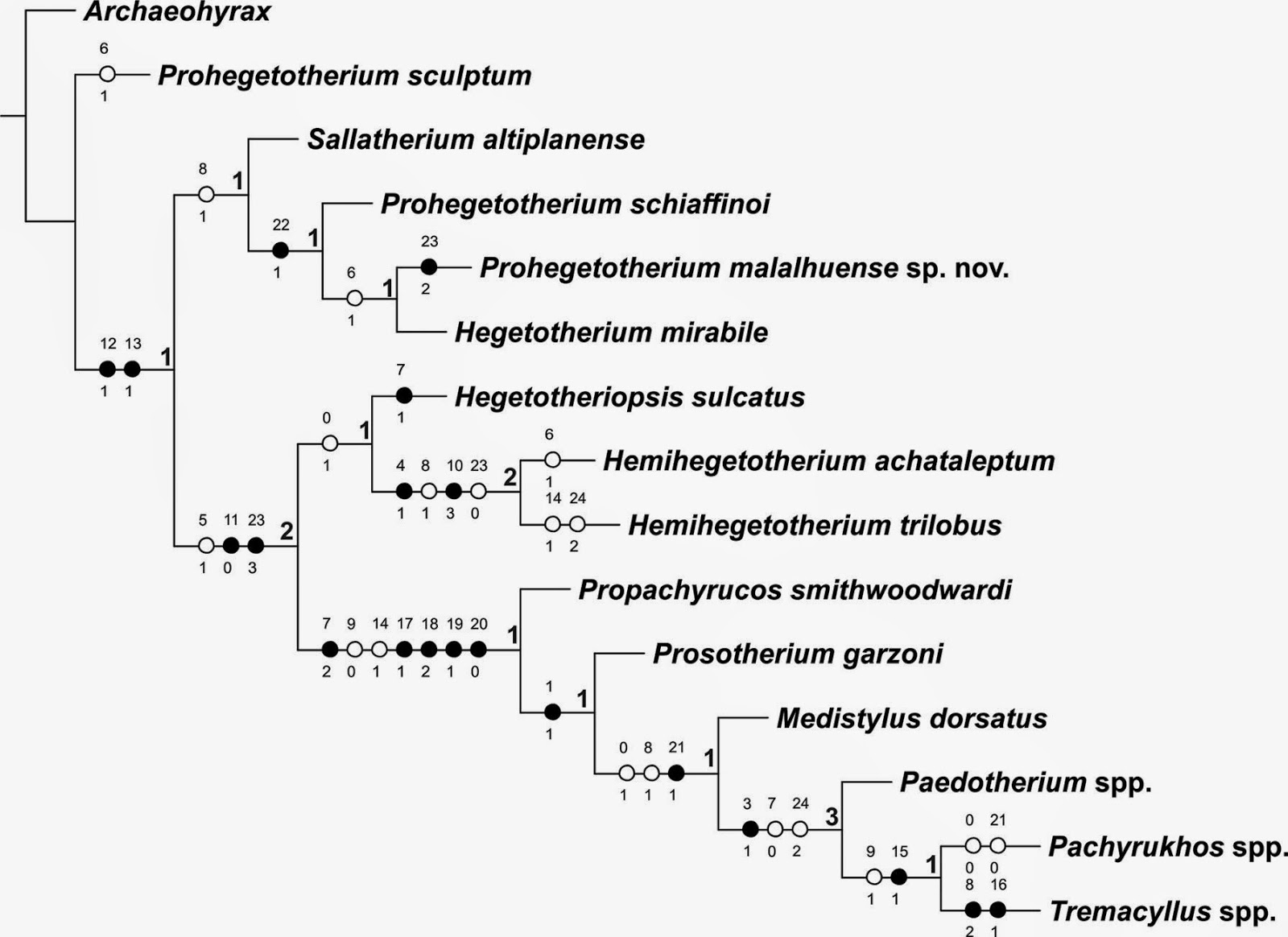
The Hegetotheriidae (Mammalia, Notoungulata) assemblage from the late Oligocene of Mendoza, central-western Argentina
Authors:
Cerdeño et al
Abstract:
This study describes new remains of Hegetotheriidae (Notoungulata), including a new species, from the Deseadan (late Oligocene) of Quebrada Fiera, Mendoza Province, Argentina. The assemblage is composed of four hegetotheriines, Prohegetotherium cf. P. sculptum, Prohegetotherium sp., Prohegetotherium schiaffinoi, and Prohegetotherium malalhuense, sp. nov., and the pachyrukhine Propachyrucos cf. P. simpsoni. The presence of Prosotherium cannot be totally discounted because lower molariforms are rather similar between the two pachyrukhine genera. The new species Prohegetotherium malalhuense, sp. nov., differs from all previously described hegetotheriines by having a lingually projecting, sharp parastyle and marked parastyle groove on the ectoloph of M2–3; talonid of m1–2 posterolabially projected; talonid of m3 with marked posterolabial groove; and the smaller size. Its phylogenetic affinities are not well resolved. Prohegetotherium is paraphyletic, with P. sculptum sister taxon to the remaining hegetotheres, and the new taxon more closely related to Hegetotherium mirabile than to P. schiaffinoi. The recognition of P. schiaffinoi and Prohegetotherium cf. P. sculptum emphasizes that the fauna from Quebrada Fiera shares elements with roughly contemporaneous Deseadan faunas from northern and southern latitudes, but important faunal particularities distinguish the region as well. The record of pachyrukhines at Quebrada Fiera more closely resembles Deseadan faunas in Patagonia than temporally correlative faunas from Bolivia and Uruguay, and indicates the presence of suitable habitats in mid-latitudes of Argentina for this hypselodont clade. Faunal affinities together with particular taxa from Quebrada Fiera appear to support a significant faunal provinciality in South America during the late Oligocene.
Was the Ediacaran/Cambrian Radiation Unique?
Was the Ediacaran—Cambrian radiation a unique evolutionary event?
Author:
Erwin
Abstract:
The extent of morphologic innovation during the Ediacaran—Cambrian diversification of animals was unique in the history of metazoan life. This episode was also associated with extensive changes in the redox state of the oceans, in the structure of benthic and pelagic marine ecosystems, in the nature of marine sediments, and in the complexity of developmental interactions in Eumetazoa. But did the phylogenetic and morphologic breadth of this episode simply reflect the unusual outcome of recurrent evolutionary processes, or was it the unique result of circumstances, whether in the physical environment, in developmental mechanisms, or in ecological interactions? To better characterize the uniqueness of the events, I distinguish among these components on the basis of the extent of sensitivity to initial conditions and unpredictability, which generates a matrix of possibilities from fully contingent to fully deterministic. Discriminating between these differences is important for informing debates over determinism versus the contingency in the history of life, for understanding the nature of evolutionary theory, and for interpreting historically unique events.
Monday, March 23, 2015
Wait! What did Boeing Just Patent?! An Active Protection System for /Shockwaves/?!

Boeing's new patent may let the force be with you even in real life.
The aircraft and defense company has taken a cue from science fiction with its plan to develop a Star Wars-style force field that would use energy to deflect any potential damage.
Just liking the luminescent shields seen in the film, Boeing's "Method and system for shock wave attenuation via electromagnetic arc" could provide a real-life layer of protection from nearby impacts to targets.
The downside: It won't protect from direct hits.
The system can sense when a shock wave generating explosion occurs near a target. An arc generator then determines the small area where protection is needed from the shock waves.
It then springs into action by by emitting laser pulses that ionize the air, providing a laser-induced plasma field of protection from the shock waves.
"Explosive devices are being used increasingly in asymmetric warfare to cause damage and destruction to equipment and loss of life. The majority of the damage caused by explosive devices results from shrapnel and shock waves," the patent says.
link.
Canadians as Naughty as Americans: the Cyber Activities of Canada's CSEC

Top-secret documents obtained by the CBC show Canada's electronic spy agency has developed a vast arsenal of cyberwarfare tools alongside its U.S. and British counterparts to hack into computers and phones in many parts of the world, including in friendly trade countries like Mexico and hotspots like the Middle East.
The little known Communications Security Establishment wanted to become more aggressive by 2015, the documents also said.
Revelations about the agency's prowess should serve as a "major wakeup call for all Canadians," particularly in the context of the current parliamentary debate over whether to give intelligence officials the power to disrupt national security threats, says Ronald Deibert, director of the Citizen Lab, the respected internet research group at University of Toronto's Munk School of Global Affairs.
"These are awesome powers that should only be granted to the government with enormous trepidation and only with a correspondingly massive investment in equally powerful systems of oversight, review and public accountability," says Deibert.
Details of the CSE’s capabilities are revealed in several top-secret documents analyzed by CBC News in collaboration with The Intercept, a U.S. news website co-founded by Glenn Greenwald, the journalist who obtained the documents from U.S. whistleblower Edward Snowden.
link.
Documents obtained from Edward Snowden reveal the extent of the cyberwarfare techniques used by Canada’s Communications Security Establishment Canada (CSEC) – including the capacity and will to perform ‘false flag’ operations, where responsibility for cyberattacks, counterattacks or other intelligence-related activity is misattributed to individuals, groups or nation states.
The Intercept, in collaboration with the Canadian Broadcasting Corporation (CBC), has published limited details of CSEC’s cyberwarfare capabilities and disposition just as Canada’s C-51 bill – draft anti-terrorism legislation currently under criticism for its potential to silence legitimate protest – is under fierce debate in Canada’s House of Commons.
The ‘deception tactics’ outlined by the documents include ‘false flag’ techniques, carried out in order to ‘create unrest’. In a spectacular display of bureaucratic legerdemain, this process is apparently defined as ‘[altering] adversary perception’.
The new leak also reveals that CSEC uses ‘honeypot’ or ‘watering hole’ techniques in service of generating deceptive cyberactivity; though no greater detail is given on that point, the principle is one of presenting a tempting online target and attempting to gain advantage from the actors attracted to it.
Additionally the leaked information discloses CSEC’s cooperation with the NSA in service of an ‘active computer network access and exploitation on a variety of foreign intelligence targets, including CT [counter terrorism], Middle East, North Africa, Europe, and Mexico’.
link.
US Navy Asks Congress for Additional 12 F/A-18E/Fs and 8 F-35Cs Outside of Normal Budget

The U.S. Navy included 12 Boeing Co F/A-18 Super Hornet fighter jets and eight Lockheed Martin Corp F-35s on a list of "unfunded priorities" prepared for Congress, defense officials and other sources familiar with the matter told Reuters.
The Navy's list was reviewed by senior Pentagon officials and the Joint Chiefs of Staff this week, and should be sent to U.S. lawmakers in coming days, said the sources, who asked not to be named because the vetting is still under way.
Top Pentagon officials are skeptical about the weapons wish lists, and worry they help lawmakers "cherry pick" specific weapons programs to fund, while crowding out bigger priorities. However, they say they will not stand in the way of the military services complying with requests from lawmakers.
The total value of the additional 12 Boeing jets is around $1 billion, while the eight extra Lockheed jets would be just over $1 billion, the sources said.
A decision by Congress to fund the extra Boeing jets as part of the Navy's fiscal 2016 budget would help the company extend its St. Louis production line beyond the end of 2017, although it was not immediately clear for how long.
link.
Link Between Milankovitch Cycle and Pleistocene Ice Age Questioned
A new international study casts doubt on the leading theory of what causes ice ages around the world -- changes in the way the Earth orbits the sun.
The researchers found that glacier movement in the Southern Hemisphere is influenced primarily by sea surface temperature and atmospheric carbon dioxide rather than changes in the Earth's orbit, which are thought to drive the advance and retreat of ice sheets in the Northern Hemisphere.
The study raises questions about the Milankovitch theory of climate, which says the expansion and contraction of Northern Hemisphere continental ice sheets are influenced by cyclic fluctuations in solar radiation intensity due to wobbles in the Earth's orbit; those orbital fluctuations should have an opposite effect on Southern Hemisphere glaciers.
"Records of past climatic changes are the only reason scientists are able to predict how the world will change in the future due to warming. The more we understand about the cause of large climatic changes and how the cooling or warming signals travel around the world, the better we can predict and adapt to future changes," says lead author Alice Doughty, a glacial geologist at Dartmouth College who studies New Zealand mountain glaciers to understand what causes large-scale global climatic change such as ice ages. "Our results point to the importance of feedbacks -- a reaction within the climate system that can amplify the initial climate change, such as cool temperatures leading to larger ice sheets, which reflect more sunlight, which cools the planet further. The more we know about the magnitude and rates of these changes and the better we can explain these connections, the more robust climate models can be in predicting future change."
link.
How Mesozoic Mammals Moved
A multivariate approach to infer locomotor modes in Mesozoic mammals
Authors:
Chen et al
Abstract:
Ecomorphological diversity of Mesozoic mammals was presumably constrained by selective pressures imposed by contemporary vertebrates. In accordance, Mesozoic mammals for a long time had been viewed as generalized, terrestrial, small-bodied forms with limited locomotor specializations. Recent discoveries of Mesozoic mammal skeletons with distinctive postcranial morphologies have challenged this hypothesis. However, ecomorphological analyses of these new postcrania have focused on a single taxon, a limited region of the skeleton, or have been largely qualitative.
For more comprehensive locomotor inference in Mesozoic mammals, we applied multivariate analyses to a morphometric data set of extant small-bodied mammals. We used 30 osteological indices derived from linear measurements of appendicular skeletons of 107 extant taxa that sample 15 orders and eight locomotor modes. Canonical variate analyses show that extant small-bodied mammals of different locomotor modes have detectable and predictable morphologies. The resulting morphospace occupation reveals a morphofunctional continuum that extends from terrestrial to scansorial, arboreal, and gliding modes, reflecting an increasingly slender postcranial skeleton with longer limb output levers adapted for speed and agility, and extends from terrestrial to semiaquatic/semifossorial and fossorial modes, reflecting an increasingly robust postcranial skeleton with shorter limb output levers adapted for powerful, propulsive strokes. We used this morphometric data set to predict locomotor mode in ten Mesozoic mammals within the Docodonta, Multituberculata, Eutriconodonta, “Symmetrodonta,” and Eutheria. Our results indicate that these fossil taxa represent five of eight locomotor modes used to classify extant taxa in this study, in some cases confirming and in other cases differing from prior ecomorphological assessments. Together with previous locomotor inferences of 19 additional taxa, these results show that by the Late Jurassic mammals had diversified into all but the saltatorial and active flight locomotor modes, and that this diversification was greatest in the Eutriconodonta and Multituberculata, although sampling of postcranial skeletons remains uneven across taxa and through time.
Subscribe to:
Posts (Atom)